A school desk is not an office desk. Office workers sit gently. They do not lean back on two legs. They do not drag the desk across the floor. They do not spill glue or carve initials into the surface. A school desk and chair needs to survive all of that. Every day. For years. The furniture also needs to fit students of different sizes. Too small, and tall students cannot write comfortably. Too large, and small students cannot reach the desktop.
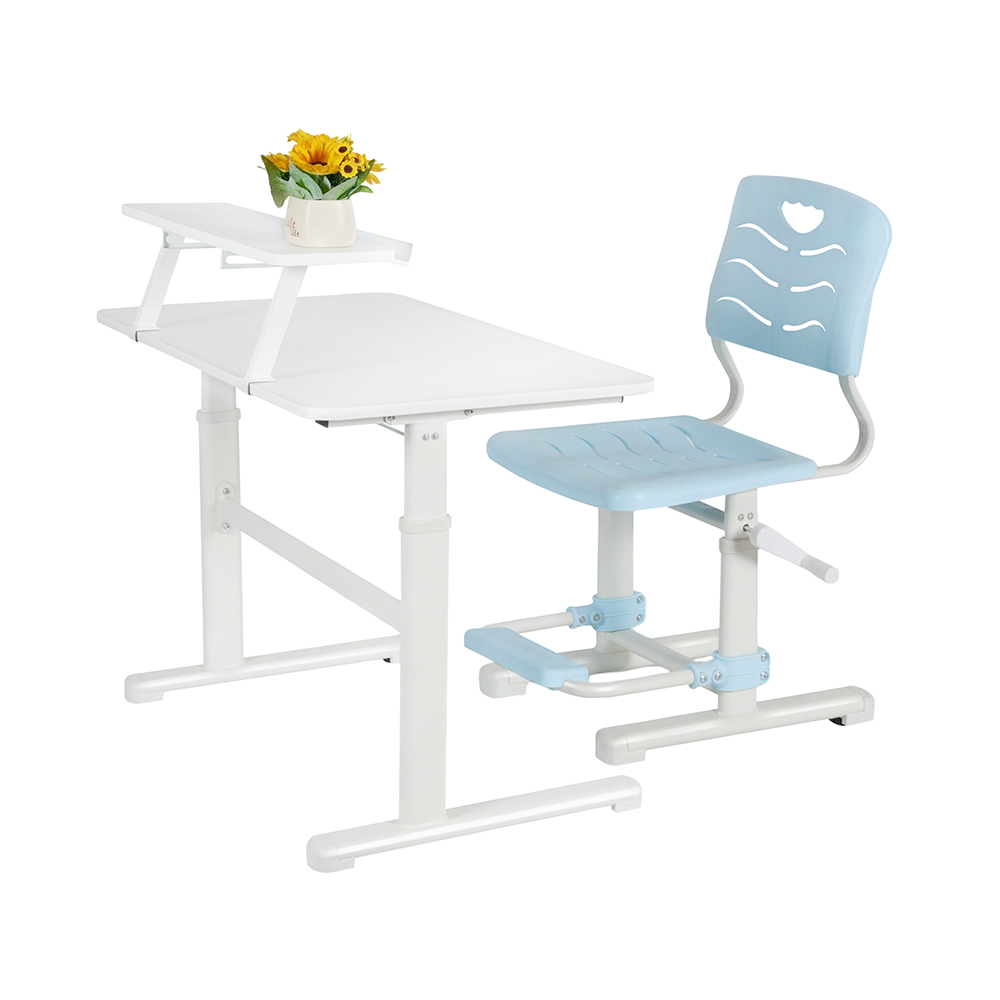
The desk frame needs to handle abuse without bending or breaking
An office desk has thin metal legs. They are fine for holding a computer and a coffee mug. A school desk and chair has a thicker frame. The legs are welded from steel tube, not bolted together. Bolts loosen. Welds hold. The frame is powder-coated, not painted. Powder coating resists scratches. Paint chips.
The desk height is adjustable in many models. The student grows. The desk grows with them. A school desk and chair with 20 centimeters of height adjustment covers multiple grade levels. The adjustment mechanism needs to be tool-free. A teacher or custodian should adjust the desk in seconds.
The chair needs to stack or nest for storage
Classrooms get cleaned daily. Floors are mopped. Desks and chairs move. A school desk and chair that does not stack takes up too much space. Chairs that nest or stack store in a corner. Desks that fold or nest reduce cleaning time.
Here is what a school desk and chair needs for practical daily use:
Desk tops need to resist scratches, stains, and impacts
High-pressure laminate (HPL) is the standard for school desk and chair tops. HPL is paper layers soaked in resin, pressed under high heat and pressure. The surface is hard. Knives and compass points do not scratch it easily. Spilled juice and markers wipe off. The edge of the desktop needs impact protection. Solid plastic edging or a full wraparound bumper prevents chipping.
Solid plastic desktops are another option. Polyethylene or polypropylene. These surfaces are softer than HPL. They scratch easier. But they are less expensive. For elementary schools where the budget is tight, solid plastic works.
Chair seats and backs need comfort without being too soft
A school desk and chair with padded seats looks comfortable. The padding tears. The foam compresses. The vinyl covering cracks. Hard plastic seats are better for schools. Polypropylene seats are durable. They clean easily. They do not absorb spills. The shape provides comfort — contoured for the back and thighs.
Wood seats exist but are uncommon. Wood is heavy. Wood splinters. Wood scratches. For many schools, plastic is the better choice.
Desk height needs to match the student, not the other way around
A school desk and chair that is too high makes the student hunch their shoulders. Too low, and the student slouches. Bad posture leads to back pain and distraction.
Typical desk heights by grade:
Adjustable desks cover multiple ranges. A single school desk and chair model might adjust from 52 to 70 centimeters. The school buys one model for all grades. The teacher adjusts as students grow.
Chair height needs to let the student's feet rest flat on the floor
When a student sits in a school desk and chair, their feet should touch the floor. If feet dangle, the student shifts around. They kick the desk legs. They lean forward. They get distracted.
Chair height increments are smaller than desk increments. A student's leg length changes slowly. A chair that adjusts in 2-centimeter steps works well.
Weld joints crack from student abuse
Students lean back on chairs. They stand on desks. Cheap school desk and chair products have weak welds. The weld cracks. The frame becomes wobbly. The chair collapses. A student gets hurt.
Good furniture has full-penetration welds. The weld is as strong as the base metal. The weld bead is smooth, not spattered.
Desk tops delaminate from moisture and impacts
Cheap HPL tops use low-quality adhesive. The laminate separates from the particle board core. The edges lift. Water gets under the laminate. The desktop swells. The surface is ruined.
Better desktops use moisture-resistant particle board or solid plastic. The edge banding is applied with hot melt adhesive that seals the core.
Plastic chair seats crack at the stress points
A school desk and chair with a plastic seat has stress points. The corners of the seat. The points where the seat bolts to the frame. Cheap plastic is brittle. It cracks. The chair breaks.
Good plastic seats use polypropylene with reinforcing ribs. The ribs distribute stress. The seat flexes without breaking.
A school desk and chair is not furniture. It is equipment. It gets used harder than alManyany other piece of furniture in any building. The frame needs to be steel. The desktop needs to be HPL or solid plastic. The seat needs to be polypropylene. Adjustability is worth the extra cost. So are full-penetration welds and moisture-resistant edges. Schools that buy cheap furniture replace it every few years. Schools that buy quality furniture replace it when the building is renovated. The upfront cost is higher. The long-term cost is lower.

Live up to the trust of every customer and strive to create high-quality Shanfeng.
Find Us
Product Center
Contact Details

 English
 русский
 عربى
عربى
 中文简体
中文简体
